It’s a fact–worry can cause you to prepare for things that complacent people don’t.
But there’s a catch.
Those who are not inclined to worry shouldn’t take up the practice without knowing a few things first.
Huh?
I know you’re confused now and this topic is a little more sophisticated then meets the eye. You were assuming a simple post about the benefits of worry over complacency. It’s not. Nor is the subject so black and white.
They are actually two different styles of preparation that are owned by two distinct personality types. And if they trade with one another, it can backfire.
So first, let’s cover some of the basics; some of the tenets of each style and each personality.
Defensive Pessimism
First of all, psychologists have a spiffy name for worriers. It’s “deffensive pessimists”. Ok.
Are you a worrier? Here are some of the benefits:
1.Anxiety as Motivation
Psychologists say people who set low expectations for themselves use anxiety as fuel for preparation. Unlike complacent individuals who may under-prepare worriers channel their nervous energy to get ready.
2. Superior Preparation
Defensive pessimists tend to engage in more thorough mental rehearsal and contingency planning. By imagining what could go wrong they develop backup plans and are less likely to be caught off-guard. Studies show that interfering with this strategy (by forcing positive thinking) actually decreases their performance .
3. Maintained Focus Under Pressure
Research comparing defensive pessimists to “strategic optimists” found that while optimists perform best when they distract themselves or relax before tasks, defensive pessimists actually perform worse when forced to relax or think positively. Worrying keeps them alert and focused. As I said before, worriers are supposed to be worried.
4. Protection Against Complacency
The complacent may have overconfidence bias meaning underestimating challenges and under-preparing. “Defensive pessimists” avoid this trap by assuming things will be difficult, which drives them to work harder .
Drawbacks to Worry
Unmanaged anxiety is different from defensive pessimism used strategically. There is productive worry (used for preparation) and debilitating anxiety that paralyzes action .
Self-handicapping vs. defensive pessimism: There’s a crucial distinction between defensive pessimism (which doesn’t harm performance) and self-handicapping (creating excuses for your performance or lack thereof) which causes you to fall short.
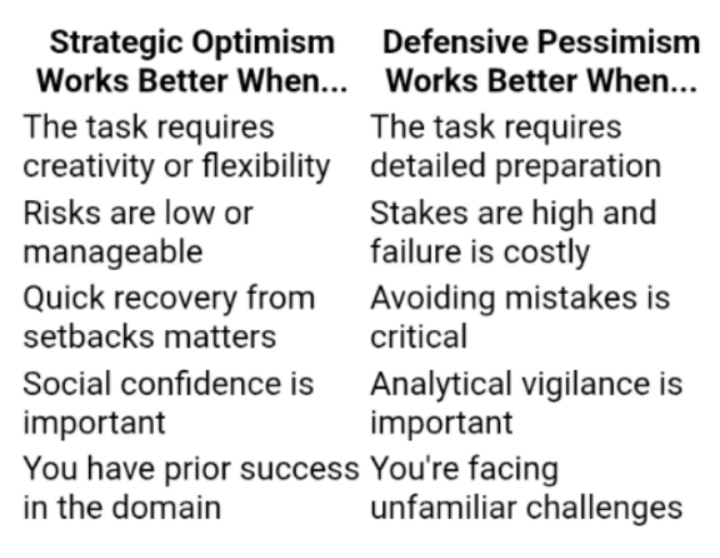
Context: Defensive pessimism works best in achievement contexts where preparation pays off. It may not be adaptive in situations requiring creativity or social risk-taking .
While defensive pessimism can boost short-term performance, some research suggests it may lead to decreased life satisfaction and emotional instability.
It’s not about being a “worrier” versus being “positive”—it’s about whether your mindset drives effective preparation. Defensive pessimists perform well not because anxiety is inherently good, but because they’ve learned to harness it productively .
Strategic Optimism
As you might expect, there’s a term for those who are “positive”. I fall into this category oftentimes and have attracted a fair amount of attention for it unintentionally. Once upon a time I was so difficult to rattle that people would literally give Me trouble or throw problems in My way just to watch how I would handle it. These people are called “strategic optimists” for their belief that there’s always a way to solve a problem.
Benefits:
1. Emotional Resilience & Well-being
Strategic optimists generally experience less pre-performance anxiety and emotional volatility. They don’t need to catastrophize to get motivated, which means less psychological wear and tear .
2. Quick Recovery from Setbacks
Because they expect positive outcomes, strategic optimists tend to bounce back faster from failures. They don’t ruminate as much on what went wrong and are more likely to view setbacks as temporary.
3. Better Performance in Certain Domains
Optimists often excel in situations requiring:
– Creativity and innovation (where anxiety can narrow thinking)
– Social risk-taking (networking, public speaking, leadership)
– Physical performance (sports, where relaxation aids execution)
4. Efficient Energy Use
They focus attention on success strategies and positive outcomes, which can be more efficient when risks are low .
5. Health Benefits
Research outside the defensive pessimism literature consistently links optimism to better physical health outcomes, stronger immune function, and longer lifespan .
Downsides
1. Vulnerability to Complacency
This connects to your original research point. Strategic optimists may under-prepare because they assume things will work out. Without the “productive anxiety” that drives defensive pessimists to rehearse and plan, they can be caught off-guard .
2. Poor Performance When Forced to Worry
Interestingly, when strategic optimists were forced to engage in defensive pessimism strategies (dwelling on worst-case scenarios), their performance actually decreased. Their natural coping style is disrupted by worry .
3. Blindsided by Real Risks
Because they don’t habitually scan for threats, strategic optimists may miss warning signs that defensive pessimists would catch. They can fall victim to overconfidence.
4. Difficulty in High-Stakes, Unfamiliar Situations
When facing genuinely difficult or novel challenges where preparation is critical, strategic optimists may lack the detailed contingency planning that defensive pessimists automatically generate.
5. Potential for Self-Handicapping (in some forms)
While distinct from defensive pessimism, some optimistic strategies can border on self-deception—minimizing real problems to protect mood, which can lead to poor decisions.
I’m guilty of number 4 and 5 at times when preparing for court cases. I have a lot of success in My field and i have intimidated some very experienced and tenured people in My time from politics and law. However, success in one area doesn’t necessarily mean success in another and I still find Myself preparing to go to court just days before a trial is scheduled.
The healthiest approach may be situational flexibility—being able to deploy strategic optimism when it’s adaptive, but borrowing from defensive pessimism when preparation and risk-analysis are needed.

The Point of This is a Bonus
Now that you’ve familiarized yourself with the two different personality styles here and likely identified yourself with one of them–which is beneficial–we come to the reason I made this foray with Panic-Attack Man as our lead.
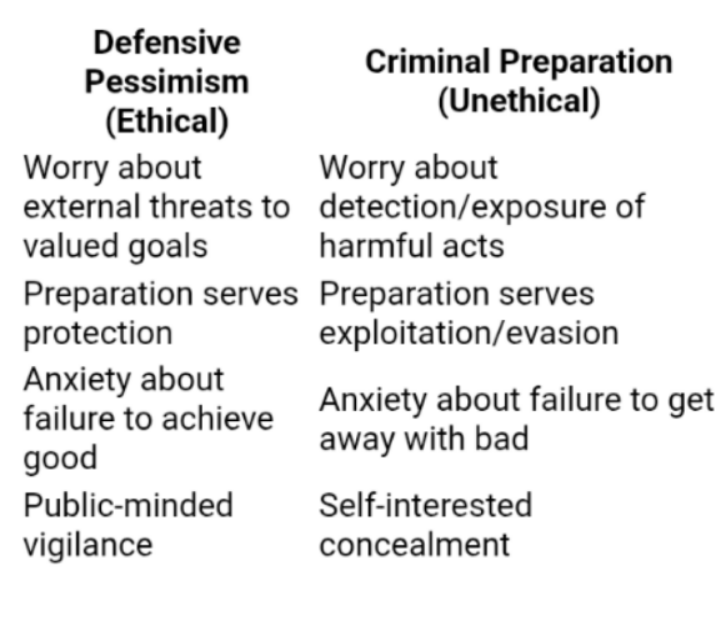
It seems to Me that in society, those with crime in their background worry. And they have a lot to worry about: Who the boss is, what he’s like, who the mayor is, where the surveillance cameras are, what is the statute of limitations on the type of crime they engage in, I could go on and on with things that crooks have to worry about.
On the other hand good people have “trust bias”. That is, they are trustworthy and often assume that others are too. As if this isn’t dangerous enough, you must realize that those who have done no wrong literally have nothing to worry about. When they hear the sirens go by, they don’t become self-conscious about the dope lying around on the floor.
And this I supposed, because it’s not preparation for an engagement, but a passive state of mind withing a game that is always at play, that being the government and police activities; politics and social relationships, that those who don’t worry naturally may be at a disadvantage.
Here’s the skinny on those with criminal intent and worry:
Criminal Mindset as Hyper-Vigilance
Research on white-collar criminals and corrupt networks shows they often exhibit:- Extensive scenario planning for detection/evasion
– Paranoid operational security (who to trust, how to communicate, where vulnerabilities lie)
– System-gaming expertise—deep knowledge of institutional loopholes others ignore
They are, functionally, “defensive pessimists” about their own exposure while being “strategic optimists” about their ability to exploit others’ complacency.
Police-State Jihads
Corrupt actors invest heavily in understanding and infiltrating systems (campaign finance rules, procurement processes, oversight mechanisms)
General public and even many officials operate with “trust default”—assuming institutions self-correct, not studying loopholes, not anticipating coordinated exploitation
The “Predator-Prey” Analogues
Predators invest heavily in stalking, assessing, preparing
Prey often rely on herd safety, camouflage, or freezing—not active threat-modeling
In institutional contexts, corrupt actors are “predators” who study the “terrain” while ethical actors assume “the zookeeper” (rule of law) maintains safety.
If I Am correct not just anecdotal about those who worry in society vs. Those who don’t there would be three key takeaways:
1. Corruption persists because it invests in intelligence that integrity doesn’t
2. Democratic oversight fails when citizens don’t “worry” like criminals do—studying loopholes, anticipating exploitation, preparing contingencies
3. The “complacent” aren’t just optimistic—they’re informationally disadvantaged by their own ethical framework (assuming others sha
Furthermore it means that ethical systems have structural vulnerabilities: they assume others participate in good faith, they dont’ outsource “defensive Pessimism” at a citizen level and it punishes paranoia when there is something to worry for.
I hope this brings some things to your attention and that you have learned something about yourself and the world around you.